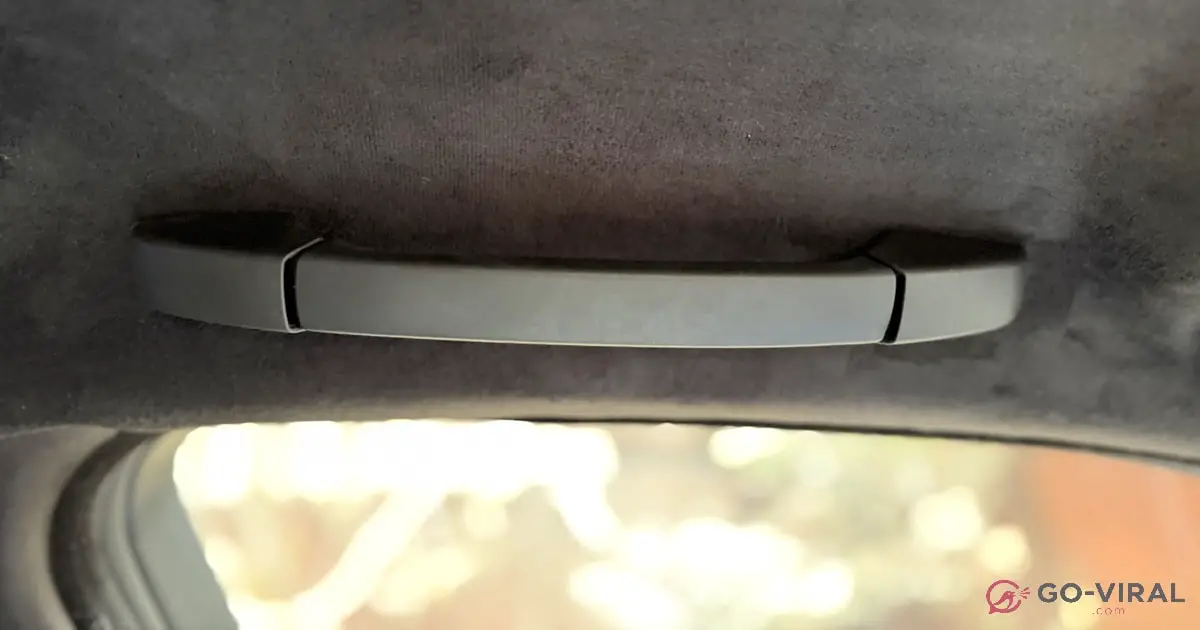
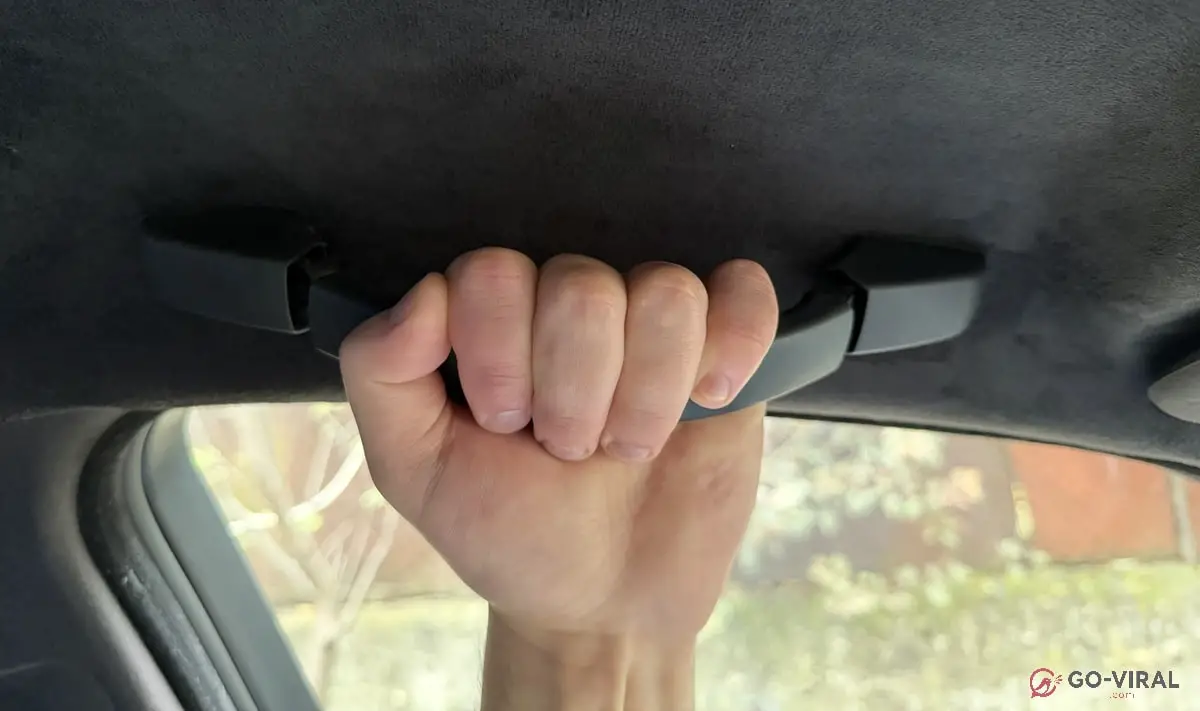
I reached for one of those padded car grab handles above the door on a sharp bend the other day, and it hit me that I had no idea what they were actually for. You grab it without thinking. Steady yourself, let go, forget it until the next curve. Most of us treat the little loop as a convenient spot for a dry-cleaning bag and leave it at that. It turns out the handle has a real job, and once you know what that job is, you start noticing where it sits and where it quietly doesn’t.
The Real Job of Car Grab Handles
Strip away the nicknames and the car grab handles above your doors are assist grips. The clue is in that name. They exist to help a body move safely in a space that moves too.
Climbing into a tall SUV or a pickup is the obvious case. You plant a foot, reach up, and the handle gives you a fixed point to pull against so you are not hauling yourself up by the door frame. Getting back out works the same way in reverse. For older passengers, or anyone with limited mobility, that fixed hold is not a nicety. It is the difference between an easy exit and an awkward one.
The grip matters on the move, too. On a winding mountain road, or during a hard stop, a passenger with nothing to hold slides and lurches. A hand on the grip keeps you planted and takes the strain off your neck and core. That is why the handle is anchored into the vehicle’s frame rather than screwed to the soft interior trim. Trim would tear loose under a real pull. The grip has to hold a sudden, full-body yank without giving, so it bolts to structure that can take it. Small part, serious engineering behind it.
Why There’s Usually No Handle Above the Driver
Here is the detail that trips people up. Look up from the driver’s seat in most cars and the handle is gone. Passenger side, rear seats, all present. Directly above the person doing the driving, nothing.
The common explanation is simple and it makes sense. The driver already has a dedicated handhold, and it is the steering wheel. Put a grab handle within easy reach and you hand a driver the temptation to brace against it on a rough patch instead of keeping both hands where they belong. On a bend or a hard stop, a driver’s hands need to be steering, not clinging to the roof. Take away the tempting alternative and the choice makes itself.
Worth saying plainly: this is the widely repeated reasoning rather than a line from a safety regulator. Some vehicles do fit a driver-side grip anyway. But the pattern holds across most cars, and the logic behind it is hard to argue with once you have heard it.
The Hidden Hook You’ve Been Ignoring
Many grab handles hide a second trick. Fold the handle down and a small plastic hook swings out, built for a suit jacket or a shirt on a hanger. That is the intended use, and it is a genuinely handy one for anyone who commutes in work clothes.
The catch is what you decide to hang there. That hook is rated for something light, a jacket, not a loaded tote or a heavy shopping bag. Overload it and you are not just risking a snapped hook. In a lot of vehicles the side-curtain airbag deploys from exactly that strip along the roofline, and a heavy bag swinging from the hook sits right in its path. In a crash, anything blocking that airbag is a problem. So the rule is easy: light garments on the hook, heavy loads on the floor or the seat. The same small car fittings we ignore for years sometimes come with reasons attached, much like opening your car door the safer way.
Oh-Sh Handles, Off-Road Grips and Other Nicknames
People rarely call these things assist grips in real life. The affectionate slang runs to the “oh-sh handle” and the “Jesus handle,” both named for the noise a passenger makes when the driver takes a corner with more enthusiasm than warning. Those are cultural nicknames, not anything a manufacturer prints in the manual, but they capture the stability job perfectly. You grab the thing when physics suddenly feels personal.
In off-road and heavy-duty vehicles the joke gets more serious. There the grips are bigger, sometimes a solid bar bolted straight to the roll structure, because passengers genuinely hang on while the truck pitches over rock and rut. The bouncier the ride, the more the humble grip earns its keep. Same basic idea as the padded loop in a family sedan, just built for punishment. For another small car fitting people misread entirely, there is the black box some drivers spot hanging from a window.
So the next bend in the road is quietly a demonstration. Notice which hand drifts up to the grip and which stays put, and you will see the whole design in a second: the passenger braced and steady, the driver’s hands exactly where they need to be.