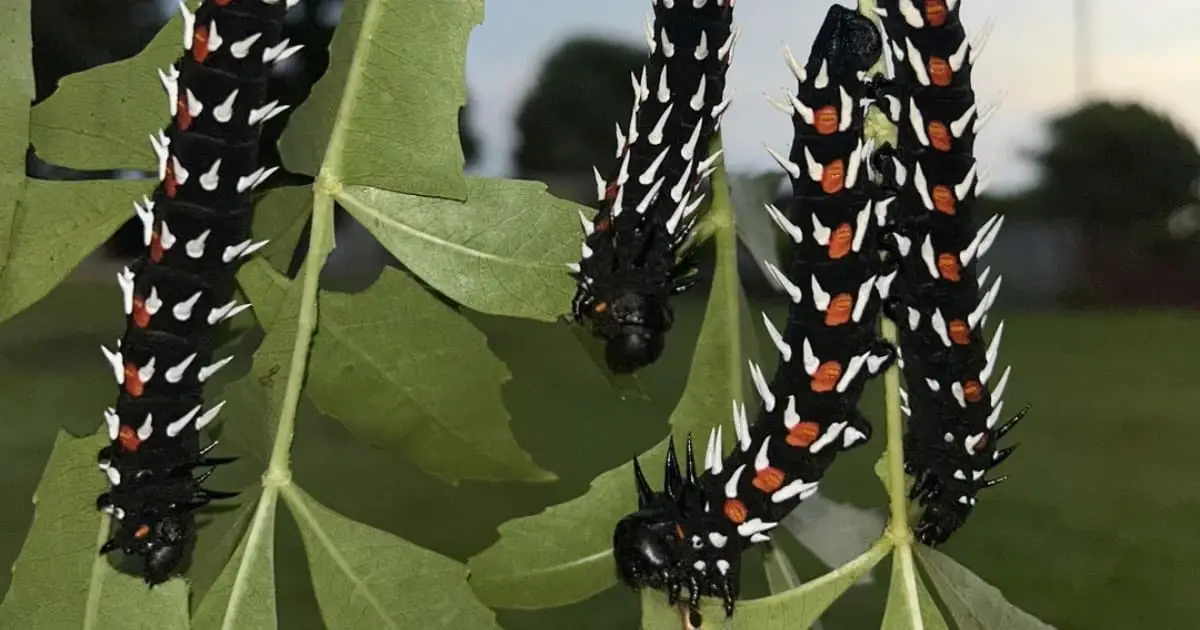
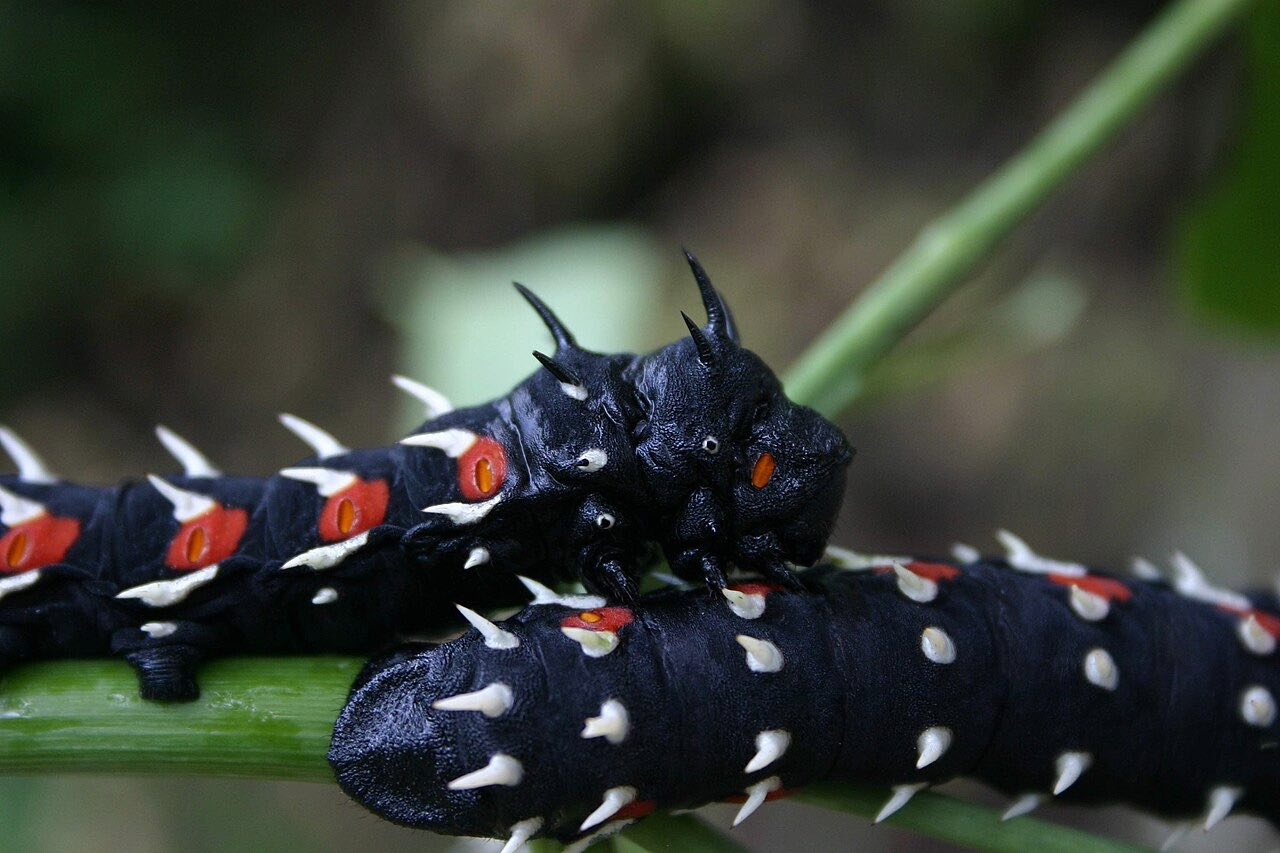
The cabbage tree emperor moth has one of the most unusual-looking caterpillar stages in Africa. Picture a velvety black body covered in rows of pale spiky tubercles. Red and orange markings cluster around its breathing holes. It is the kind of creature that sets off alarm bells at first glance, with sharp-looking spines and striking colors. Its bizarre appearance makes it look like a creature straight out of a science-fiction film. It is real, well documented, and it turns into something just as surprising.
The Caterpillar That Looks Like It Came From Another Planet
Although reddish forms also exist, mature caterpillars are commonly black, with prominent white or yellow spines. Bright orange spots mark the spiracles, the small breathing openings along the sides of its body. They break up the black like scattered embers. The overall effect is more mineral than animal, closer to something grown in a lab than hatched from an egg.
Its extraordinary appearance has attracted attention online, including in identification discussions where people compare the caterpillar to creatures from fantasy films and cartoons. The sharp-looking spines may help discourage predators, although their precise defensive role has not been firmly established. Despite its unusual appearance, the caterpillar is a normal stage in the cabbage tree emperor moth’s life cycle. Entomologists have described it in detail for years. Nothing about it is a hoax, even if the photographs do it no favors in the credibility department.
As it feeds and grows, the caterpillar passes through several larval stages called instars, shedding its skin between them. For sheer visual drama, it rivals almost any other creature in its size class. If you enjoy unusual wildlife that looks intimidating at first glance, you might also be fascinated by the Atlas moth, whose wing patterns can resemble snakes.
From Spiky Grub to a Broad-Winged Moth
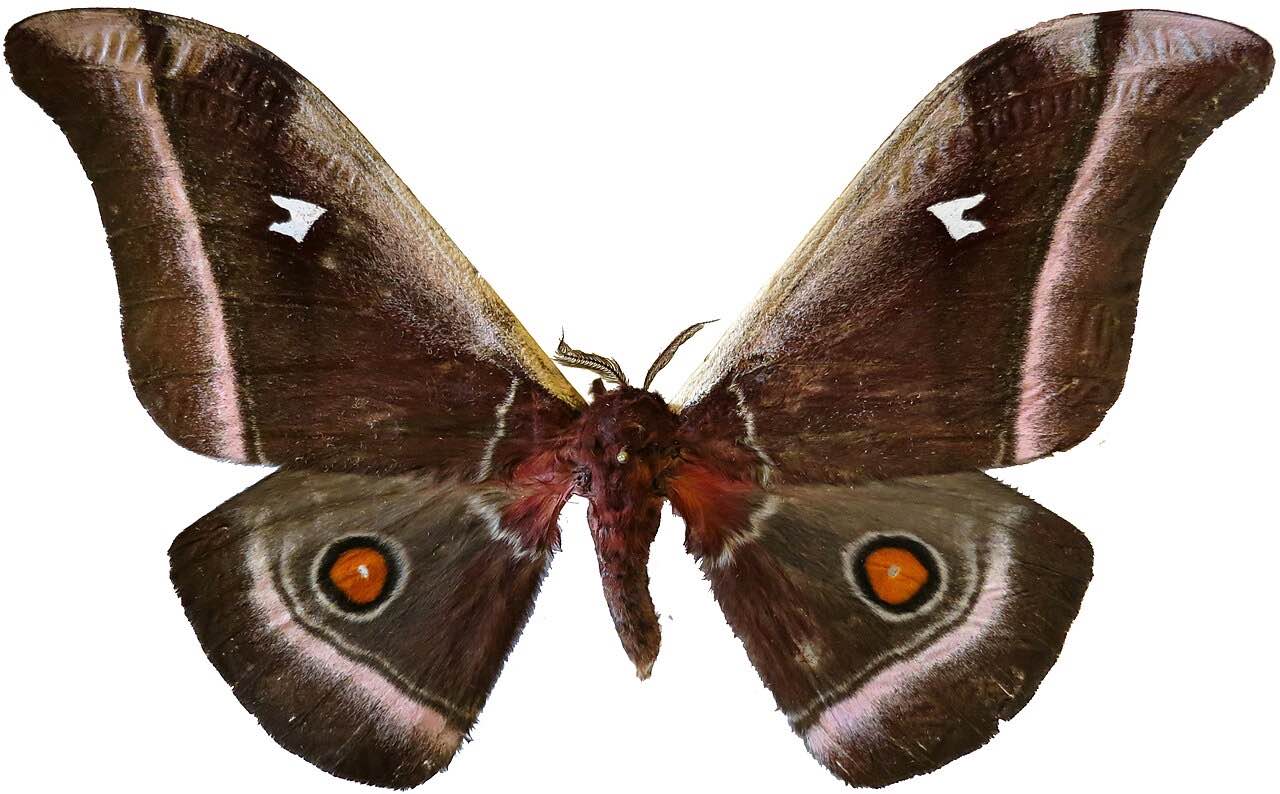
The cabbage tree emperor moth belongs to the Saturniidae, the family of emperor and giant silk moths. These are the heavyweights of the moth world, and Bunaea alcinoe is a fitting member. When the caterpillar has fed enough, it pupates, and the spiky grub disappears entirely. What emerges is a broad brown moth with a very different kind of presence.
The adult wings are a warm, earthy brown, carrying prominent eyespots that stare out like the markings on an owl. In many moths, eyespots can startle or distract predators, potentially helping the insect escape an attack. The wingspan is genuinely large, reaching roughly 4.3 to 6.3 inches across, about 110 to 160 millimeters. Figures quoted online vary depending on who measures. It is fair to treat the upper end as reported, not fixed.
The transformation is the real hook. The same animal that looked like a bristling hazard becomes a soft-winged flier that glides through the African night. If you like moths whose wings seem almost designed by hand, it shares that quality with a moth whose wings look hand-painted.
Where the Cabbage Tree Emperor Moth Actually Lives
The cabbage tree emperor moth is native to Africa, where it is widely distributed, particularly in sub-Saharan regions. It is not native to North America, so it is not a species people would normally encounter in American gardens. The species occurs in different African habitats, including wooded areas, savannas, and gardens where suitable host plants grow.
The name points to the caterpillar’s diet. It feeds on a range of host plants, including the cabbage tree, which lends the moth its common name. Like many saturniids, it is not fussy about one species. The larvae eat the foliage of several plants as they grow. That flexibility helps a creature this large find enough to eat on its way to its final size.
So the mystery dissolves into plain biology once the facts line up. Look closely, and the neat rows of pale spines become more fascinating than frightening. What first appears to be an alien creature is simply one remarkable stage in the life of the cabbage tree emperor moth.