
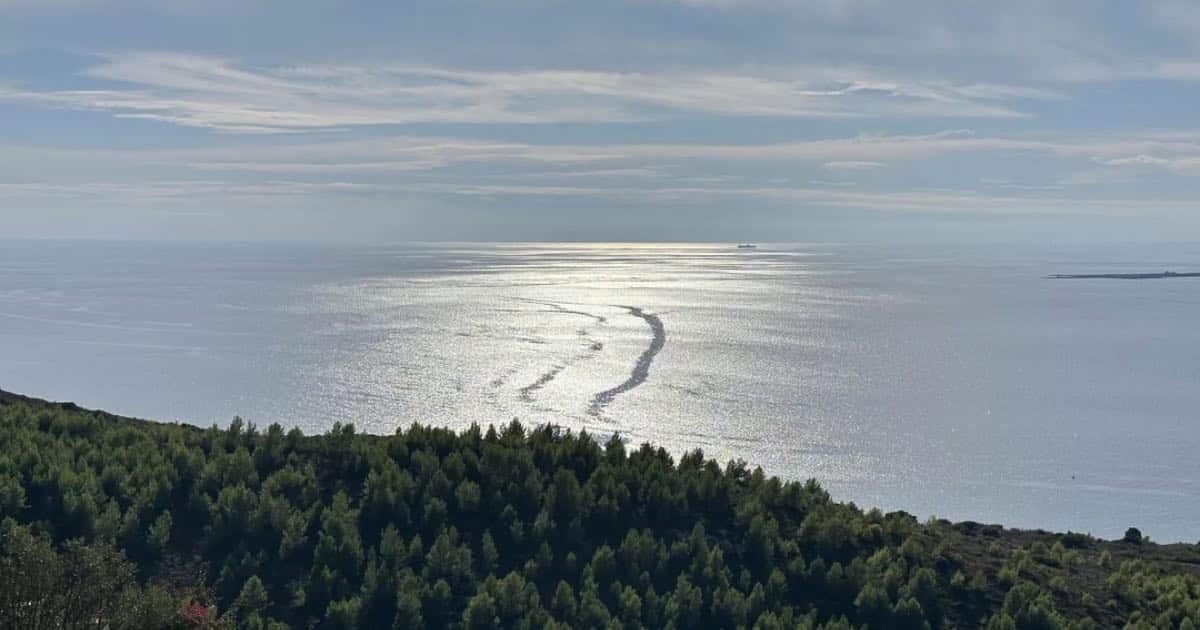
Look out over a lake or the open sea on a breezy day and Langmuir circulation might be drawing long, near-parallel lines of foam, seaweed or debris across the water, stretching off toward the horizon. They can run for tens or hundreds of meters, oddly straight, oddly regular. People may mistake the streaks for oil, unusual currents or something more concerning. When the pattern is caused by Langmuir circulation, however, the rows form as wind and waves organize the upper water into convergence zones that collect floating material.
What the Lines Across the Sea Actually Are
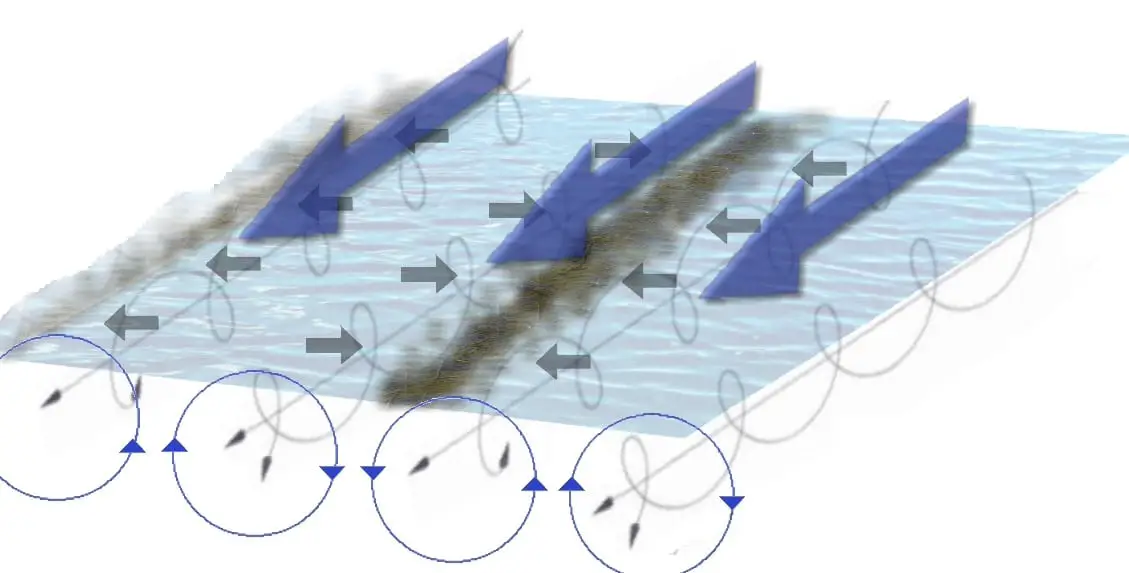
The streaks are the surface signature of long rolls of water turning just below you. Picture tubes of water lying roughly parallel to the wind, each one rotating. Neighboring rolls spin opposite ways, so between any two of them the water either sinks or rises. Where two rolls push the surface together, you get a convergence zone.
That convergence is where the lines come from. Buoyant material such as foam, pollen, floating weed and debris can drift toward those convergence zones and collect there. The rest of the surface stays comparatively clear. That is why you see tidy rows instead of an even scatter spread across the whole bay. The rows tend to line up close to the wind direction, which is why they all point the same way at once.
The Wind and the Waves Working Together
Here is the mechanism. Under favorable conditions, Langmuir circulation can form or reorganize within minutes to tens of minutes as wind and wave conditions change, although there is no single universal wind-speed threshold because wave conditions, fetch, wind duration and existing currents also matter. Modern explanations emphasize the interaction between wind-driven currents and surface waves, particularly the wave-induced motion known as Stokes drift.
Stokes drift is the small net movement of water particles in the direction that surface waves travel. Instead of returning to exactly the same position after each wave cycle, a particle can end up slightly farther along in the direction of wave propagation. The interaction between wave-induced Stokes drift and wind-driven shear can destabilize the upper flow and help organize it into long, counter-rotating cells.
So the streaks are a product of wind and waves working together, which can organize the upper water into a repeating circulation pattern. As wind and wave forcing change, individual windrows can fade, reform or shift, and Langmuir circulation can sometimes persist even after the wind weakens if wave-driven forcing remains.
How Irving Langmuir Spotted It
The phenomenon carries the name of chemist Irving Langmuir, who noticed it the way anyone might, by staring at the water on a long crossing. While crossing the Sargasso Sea in 1927, he saw rows of floating Sargassum weed lining up in long parallel bands rather than drifting at random. Most passengers would have shrugged. He did not.
Langmuir worked out that the weed was tracing something structured moving beneath the surface, not scattering by chance. He published his analysis in 1938 in a Science paper on the surface motion of water induced by wind. That observation became the basis of a piece of fluid dynamics that researchers still study today in lakes, oceans and laboratory experiments.
Why It Matters Beyond Looking Odd
The lines do real work. Those same convergence zones that gather foam can also concentrate plankton, floating weed and other buoyant material into narrow strips. These concentrations can create feeding opportunities for fish and seabirds when plankton and other prey accumulate along the surface.
The rolls matter at a larger scale too. By turning the upper water over, they mix the surface layer of the ocean, which affects temperature and how heat and gases move between the sea and the air. A pattern that looks like a quirk is quietly part of the machinery.
The streaks are easiest to see when suitable wind and wave conditions are present and foam, weed or other floating material traces the convergence zones. So a patch of debris drifting in a stubbornly straight row is worth a second look. If it is a Langmuir windrow, that tidy line marks a surface convergence associated with the hidden circulation below, a phenomenon scientifically described by chemist Irving Langmuir in 1938.