The Mysterious Device on the Light Pole

September 29, 2026
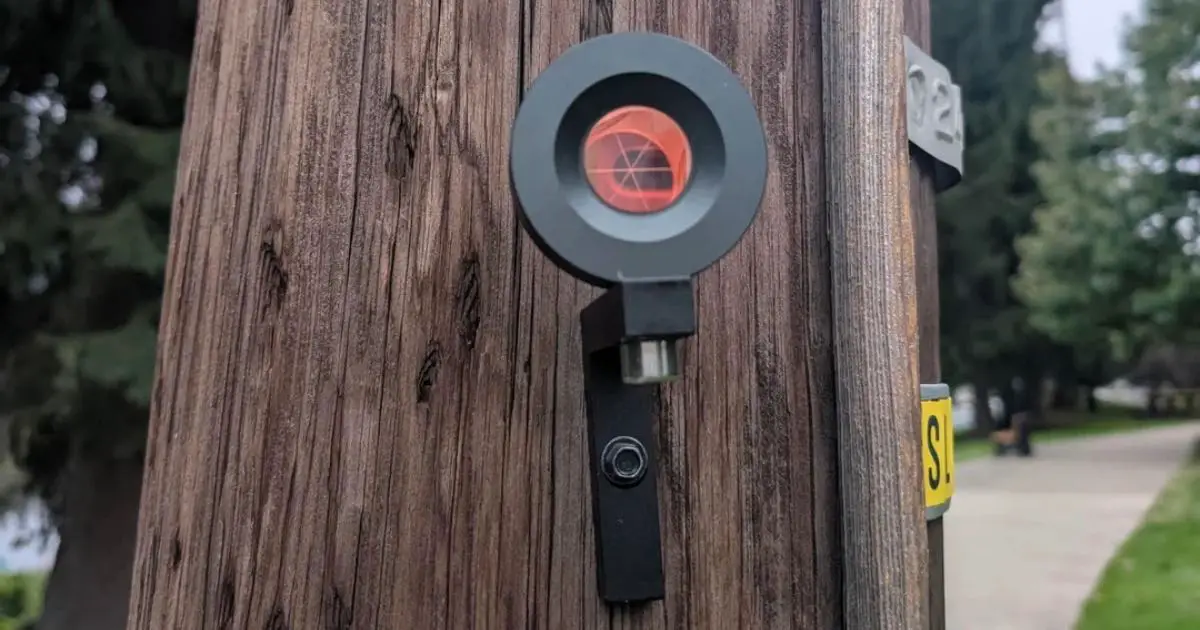
source: Reddit
A retroreflector is a small, often glassy or ridged device used on roadside posts and sometimes on poles to return light toward its source. It is not a camera or a sensor waiting to catch something. Instead, the device is an optical system designed to send much of the incoming light back toward its source. Stare at one in daylight and it looks like a dull little button. However, catch it in a car’s headlights at night and it comes alive.
That contrast is the whole trick, and it explains why these things turn up in so many places once you start noticing them.
How a Retroreflector Sends Light Straight Back
An ordinary mirror plays by a simple rule. Light hits the surface and leaves at an angle equal to the angle it arrived at. For example, Shine a flashlight at a mirror from the side and the beam bounces off to the other side, away from you. As a result, unless you are standing directly in front of it, the reflected light goes somewhere else entirely.
By contrast, a retroreflector breaks that pattern on purpose. Within its designed range of angles, a retroreflector redirects much of the incoming light back toward its source. Common retroreflective systems use cube-corner prisms or glass beads, while cat’s-eye retroreflectors use a lens-and-mirror arrangement. In a corner reflector, three flat surfaces meet at right angles, like the inside corner of a cube, and the geometry folds the incident light back the way it came. Meanwhile, the cat’s eye design does the same job with a lens paired with a mirror behind it.
You already live surrounded by them. For instance, many bicycle reflectors use molded plastic cube-corner arrays that return headlight illumination toward its source. Similarly, street signs that seem to light up in your headlights are coated with tiny beads or prisms doing exactly this. The signs are not lit from within. Instead, they are throwing your own headlights back at you.
Why One Ends Up on a Light Pole
Mount a retroreflector on a pole and you have a fixed point that can appear much brighter when a vehicle’s headlights illuminate it, returning light toward the vehicle and the driver’s viewpoint. That makes it useful for marking a pole, a curve, or a roadside hazard so it shows up clearly at night without needing any power of its own.
There is a second common job. Surveyors aim distance-measuring instruments at retroreflective targets, and a total station sends a beam toward the reflector and measures the returned signal to calculate the distance with high precision. A reflector left on a post can serve as a reference point that gets measured again and again over time.
Honesty matters here. From a single photo you often cannot tell which task a particular reflector is doing. Similar looking retroreflective devices can serve different purposes, from marking roadside hazards and guiding drivers to providing survey reference targets. Small pole-mounted devices spark a lot of curiosity, and the same instinct drives people to ask about the little white device on the traffic light pole, which is a very different piece of hardware doing a very different thing.
The Same Trick, From Roads to the Moon
Scale the idea up and it stays exactly the same physics. Surveyors use precision prisms and other retroreflective targets with total stations, and suitable instruments can measure distances with accuracy at the millimeter level.
At the other end of the scale, reflector arrays built for laser ranging over enormous distances. The principle never changes: send a beam out, let a carefully cut set of corners throw it back along its own path, and time how long the round trip takes. The plastic wedge on a bicycle wheel and the ranging targets used for serious distance measurement are cousins, running on one stubborn piece of geometry.
The giveaway is the flare. A common giveaway is that a retroreflector appears much brighter when vehicle headlights illuminate it from close to the viewer’s line of sight. The next drive past a lit-up post is a chance to catch one at work, sending much of the headlight beam back toward the vehicle and the driver’s viewpoint.