What’s the Reason Some Monarchs Are Tagged?

September 27, 2026
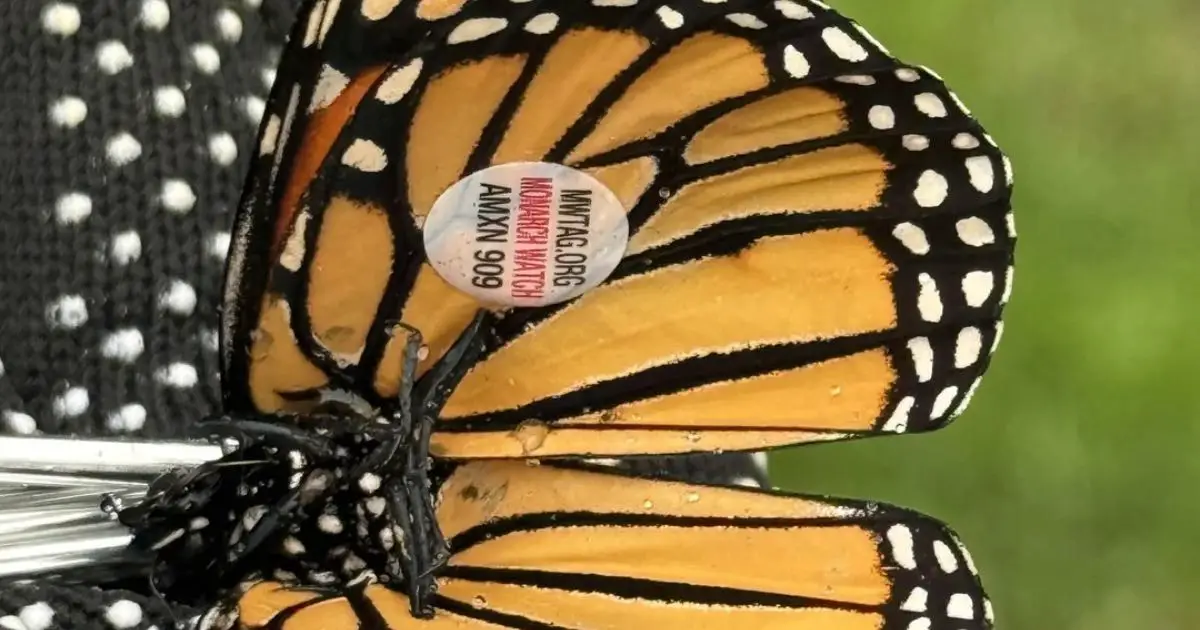
Source: Reddit
Why are some monarchs tagged is a question that usually strikes people the moment they spot a butterfly with a tiny round sticker on its wing. The tag is smaller than a fingernail and weighs almost nothing. Each one carries a printed code, which turns a single fragile insect into a data point. That little sticker connects to a migration mystery that scientists had pursued since the 1860s: where monarchs spent the winter.
Why Are Some Monarchs Tagged in the First Place
The purpose is simple even if the payoff took forever. Every standard Monarch Watch adhesive tag carries a unique identification code. When someone later finds a tagged monarch, sometimes hundreds or thousands of miles away, Monarch Watch can match its tagging location with its recovery location. Each recovery record links the monarch’s tagging date and location with its recovery date and location. Individual recoveries show elapsed time and minimum travel distance, while migration routes and timing emerge from many recoveries collected over time.
The effort to track monarchs this way reaches back a long time. Early attempts began in the late 1930s, after Fred Urquhart first tried tagging monarchs in 1937, and his experiments led to the development of the Alar Tagging Method during the 1940s as he investigated where monarchs went for winter. Recoveries gradually showed that monarchs traveled far south; Urquhart’s program tagged one monarch in Ontario in 1957, and a finder recovered it in San Luis Potosí, Mexico, in 1958. The scientific search reached a breakthrough on January 2, 1975, when Ken Brugger and Catalina Trail, then known as Cathy Brugger, came upon an overwintering colony at Cerro Pelón in central Mexico. Local residents already knew about the colonies, and in 1976 Fred Urquhart found monarch PS 397 there, a monarch that a student in Minnesota had tagged.

What the Tiny Wing Sticker Actually Is
In the Monarch Watch program, the tag is a small, lightweight adhesive circle placed over the discal cell on the underside of a hindwing. Taggers position the tag close to the butterfly’s center of lift and gravity to minimize interference with flight. Current Monarch Watch tags carry a unique identification code and the MWTAG.ORG reporting address, directing anyone who finds one to the program’s recovery system.
Applying one is a careful, gentle business, and the way volunteers press a tag onto a captured monarch before release is standardized so the data stays consistent year to year. Some programs also measure wing size in millimeters. Wing size can reflect conditions during larval development and has been associated with migration success, while researchers can combine wing size with body mass to assess an adult monarch’s body condition.
The People Behind the Tags
Community scientists, including volunteers, backyard gardeners, schools, and households, carry out much of the hands on tagging by capturing, tagging, and releasing wild monarchs or tagging monarchs they have reared. Professional researchers oversee protocols, maintain datasets, and analyze the results. In a Washington State University project launched in 2012, incarcerated participants at Washington State Penitentiary also helped rear, tag, and release monarchs for migration research.
New Zealand also operates a monarch tagging project to study movement and overwintering behavior, although a 2021 analysis found no consistent national migration pattern or common destination. The system depends on recoveries reported by members of the public, while in central Mexico Monarch Watch also obtains recovered tags from guides and ejido members at overwintering sites. When someone finds a tagged monarch or a recovered tag and reports its code, date, and location, researchers can create a specific recovery record.

What the Tags Have Revealed
The data earned its keep. Tag recoveries helped establish the long-distance migration to the overwintering forests of central Mexico and provided data on minimum travel distances, the timing and pace of migration, and the geographic origins of overwintering monarchs. Together, thousands of tag recoveries gave researchers a much clearer picture of where monarchs travel and when they move.
Tagging now feeds conservation, too. North America’s migratory monarch populations have undergone major long-term declines, with the eastern population declining substantially since the mid-1990s and the western population declining since the 1980s, although numbers can fluctuate sharply from year to year. Important questions remain about survival during migration because tag-recovery rates depend not only on whether monarchs survive the journey but also on overwintering mortality and whether people find and report the tags.
So if you ever spot a monarch resting with a small sticker on its wing, look closely for the code and report it. That one sighting might close a loop a volunteer opened hundreds of miles away.
Unusual wing patterns are worth a closer look, especially on the Picasso moth, a striking species known for its colorful, painted-looking markings.