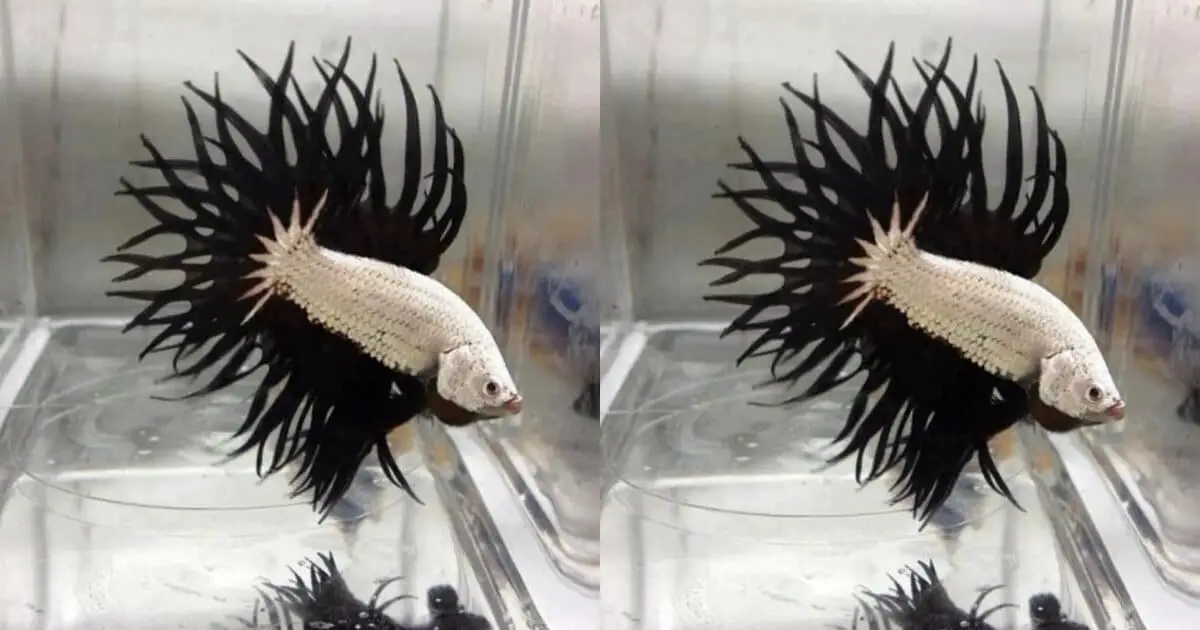
A crowntail Betta fish in a small tank can stop a person mid-scroll. The fins fan out in stiff, separate points. The tail ends up looking less like a fish and more like a spiked crown. The effect is startling the first time you see it. It seems like a strange wild species dredged up from somewhere exotic. It is nothing of the kind. This is a familiar pet-store fish, the Siamese fighting fish. People bred it into one of the most dramatic shapes in the freshwater aquarium hobby.
Up close, the “crown of thorns” turns out to be a simple trick of anatomy rather than anything mysterious.
Where the Crowntail Betta Fish Gets Its Crown of Thorns
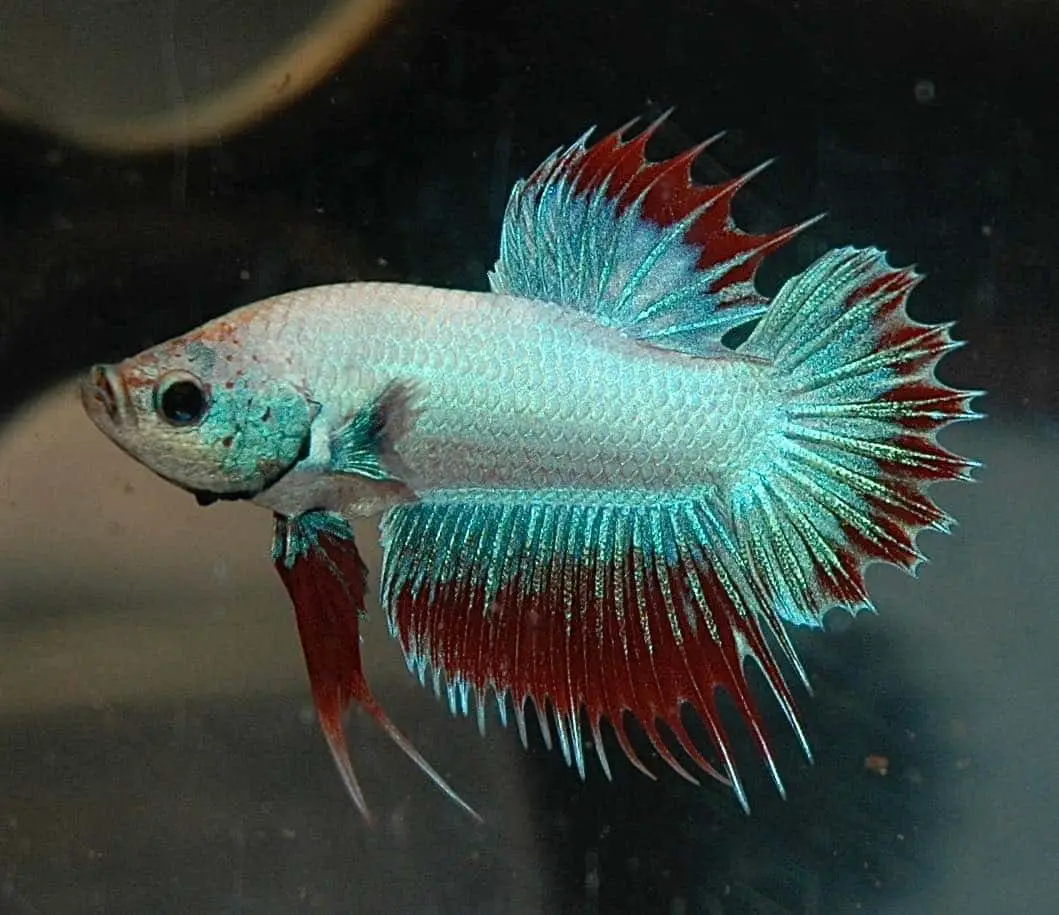
A betta’s fins are supported by thin, bony rays connected by membranes known as webbing. In many other domestic betta varieties, the webbing extends close to the fin’s edge, creating a smoother outline. In the crowntail, the webbing is reduced. It stops short, and the stiff rays carry on past it. They stick out like the teeth of a comb or the points of a crown.
That is the entire optical trick. Less webbing, more exposed ray, and a tail that spikes instead of flowing. The genetics behind it are not exotic either. A crowntail is a Betta splendens, the same species sold in cups at pet stores everywhere, the same Siamese fighting fish people have kept for generations. Breeders simply selected the fish whose fins showed the most ray extension and the least webbing. Over time, the look settled into a recognized type. The crown is a human choice, bred into a very ordinary fish.
Single, Double, and Cross-Ray: The Different Crowntail Patterns
Crowntail bettas come in several recognizable fin-ray patterns. In a single-ray crowntail, the reduced webbing leaves distinct, evenly spaced spikes. In a double-ray crowntail, the rays branch and the webbing is reduced at more than one level, giving the fins a fuller, more layered appearance. Breeders and judges also consider symmetry, spacing, and how evenly the rays extend beyond the webbing.
Then there is the striking cross-ray pattern, where neighboring fin rays curve across one another. Some hobbyists call particularly elaborate examples “king crowntails.” The crossing rays create an intricate, interwoven appearance, but the effect does not necessarily mean the rays have developed additional branches.
The quietly surprising part is that these variations are products of selective breeding. They are not separate wild species or naturally occurring ranks. Breeders developed and refined the different patterns, while aquarium organizations established standards for evaluating their appearance.
The Colors That Come With the Crown
The spikes rarely arrive alone. A crowntail Betta fish comes in a wide spread of colors: red, blue, white, yellow, copper, black, and metallic shades. Multicolor fish mix several colors at once. Set the spiked fins against a deep copper body or a near-solid blue. The crown effect sharpens even more, because the eye reads the outline against the color.
None of that palette is accidental either. The same patient selective breeding that pushed the rays out past the webbing also fixed and multiplied the colors. Fin shape and color came down the same path, chosen trait by chosen trait, generation after generation. The crown and the copper are two sides of one long project.
Why Those Spiky Fins Need Extra Care
There is a trade-off built into the look. The exposed fin rays can snag on rough decorations or become damaged by aggressive tankmates. Poor water quality and stress can also contribute to fin problems, including infections. However, a torn or frayed fin does not automatically mean the fish has fin rot.
So the showpiece is also the weak point. A crowntail does best in clean, stable, warm water with nothing jagged to snag on. The spikes are worth watching as an early warning sign. Nothing about this is cause for alarm. It is simply the trade-off of an animal bred for display. The feature everyone admires needs the most care.
That pairing of a strange look and a plain explanation is common in the water. A creature found in water that looks like something from another planet usually turns out to run on ordinary rules too.
The mystery, in the end, resolves into a fingerprint. Walk past the row of Betta cups at a pet store. The one with the stiff, splayed-out tail breaking into points is the crowntail. The crown of thorns is not an accident of nature and not a clue to some rare species. It is the visible record of people, over many generations, choosing the spikiest fish in the batch and breeding from it again.