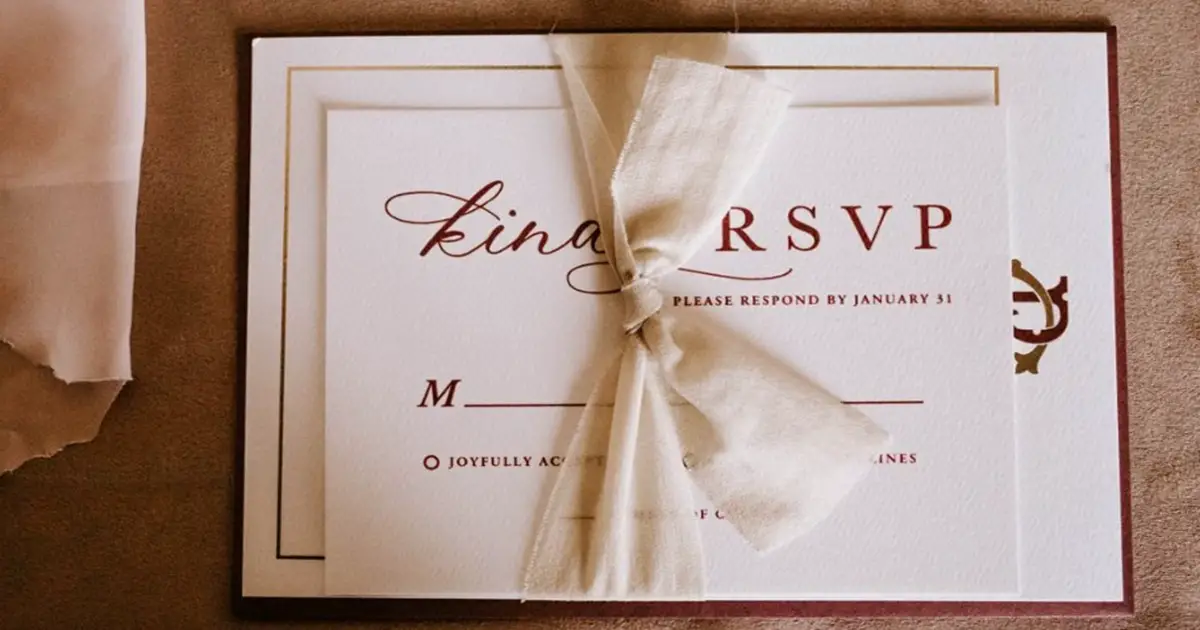
What does the M on RSVP card mean? If you’ve opened a wedding invitation, spotted an “M” followed by a long blank line, and wondered what on earth you’re supposed to write there, there’s a wonderfully simple explanation. The “M” is the beginning of a traditional courtesy title, such as Mr., Mrs., Ms., or Miss. You complete the title and then write your name on the line.
I’ll admit, it’s one of those etiquette details that seems obvious only after somebody explains it. Before that, the lonely little “M” can look oddly mysterious. Is it asking for your middle name? Your meal? Your marital status? Nope. It’s simply part of a traditional way of collecting guests’ names.
Why Is There an M on an RSVP Card?
The M on RSVP card designs is generally used with formal or traditional wedding stationery. The idea is that the guest completes the “M” to form an appropriate title and then continues with their name.
For example, a guest using “Mr.” would add “r.” after the printed M and then write their name. Someone using “Mrs.” would complete it accordingly. The same basic idea applies to Ms. and Miss. The Knot describes the M as the first letter of these common titles, while Emily Post’s sample response-card wording likewise shows an “M” immediately before the line where guests enter their names.
So, importantly, the M does not stand for “maybe,” “meal,” or the number of people attending. It’s connected to the guest’s title and name.
How Do You Fill Out the M Line?
In my experience, the easiest way to tackle this is to stop thinking of the M as a separate question. Treat it as the beginning of the name field.
If your preferred title is Mr., for instance, you would complete “Mr.” and follow it with your name. If you use Ms., you would complete “Ms.” and add your name. When more than one invited person is responding on the same card, the names of the invited guests can be written on that line as appropriate. Emily Post specifically notes that the name line can include the guest or guests and a plus-one when one has been invited.
That last part matters. An RSVP card isn’t permission to add someone who wasn’t invited. If the invitation does not include a guest, don’t add an extra name simply because there happens to be room on the line. The invitation itself should guide you as to who has actually been invited.
Trust me on this, you don’t want to skip the name line altogether, either. Hosts use response cards to determine who is attending, and a returned card without a name can create unnecessary detective work.
What If My Title Doesn’t Begin With M?
Here’s where an old stationery convention meets modern life.
Not everybody uses Mr., Mrs., Ms., or Miss. Someone may use Dr., another professional or social title, Mx., or no courtesy title at all. Emily Post’s current guidance emphasizes using the title an individual prefers.
The Knot also notes that couples do not have to use the traditional M line on their RSVP cards. A simple “Name:” followed by a blank line is an alternative and avoids requiring guests to fit themselves into an M-based title format.
If you’re designing your own invitations, I actually like that approach for its sheer clarity. Nobody has to stare at a mysterious letter while holding a pen over expensive stationery wondering whether there will be an etiquette exam afterward.
Does Every RSVP Card Need an M?
No. The M on RSVP card wording is a convention, not a requirement.
Modern response cards can simply provide a blank line for names. Couples can also collect RSVPs through other methods, including email or telephone; Emily Post specifically recognizes those as alternatives when the necessary contact information is provided.
The purpose of the response process is much more practical than the stationery tradition surrounding it. Hosts need to know who will attend. Response cards help provide an accurate guest count, and they may also collect information such as entrée choices when the reception offers meal options.
One thing I learned the hard way about etiquette questions in general is that it’s easy to mistake “traditional” for “mandatory.” They aren’t the same thing. The M line is a traditional format, but couples are free to choose clearer wording that better suits their event and guests.
And What Does RSVP Itself Mean?
Since we’re decoding tiny pieces of wedding stationery, RSVP is worth clearing up too.
RSVP comes from the French phrase “Répondez, s’il vous plaît,” meaning “please reply” or “please respond.” When an invitation asks for an RSVP, the host wants you to confirm whether you will attend. Emily Post advises guests to respond promptly and, when a deadline is provided, no later than that date.
So the RSVP tells you to respond, while the M line gives you a traditional place to identify yourself. Two little pieces of etiquette doing two different jobs.
The mysterious M is really not mysterious at all. On a traditional RSVP card, it begins a courtesy title such as Mr., Mrs., Ms., or Miss, followed by the guest’s name.
If you’re filling out a card, use the name and preferred title appropriate for you and include only people who were actually invited. If you’re creating RSVP cards yourself, you don’t have to include the M. Using “Name:” or another straightforward name field is perfectly workable and may be clearer for a wider range of guests.
From my own perspective, that’s probably the nicest thing about understanding this tradition: once you know what the M is doing there, you can either use it confidently or decide you don’t need it. And the next time one appears in your mailbox, at least you won’t spend five minutes wondering whether it somehow stands for “menu.”